
Making milk without cows seems like something out of a children’s science book ten years ago. These days, health-conscious stores carry it on their shelves. This transition occurred because synthetic biology began to treat milk as a molecular puzzle rather than merely a farm product, not because dairy farmers abruptly changed their practices.
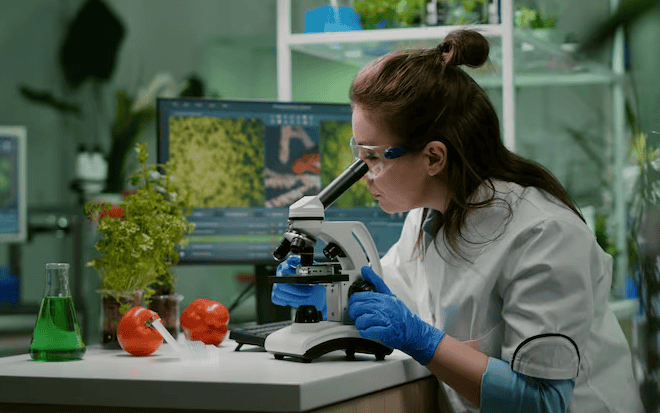
This strategy is especially creative. Companies like Perfect Day have created microorganisms that generate casein and whey, the two main proteins in dairy, rather than using animals to replicate. The method is incredibly efficient, eliminating cattle that release methane and reducing water consumption. It is no longer a scientific experiment. It is a functional food system that is independent of feed grain, pasture, and antibiotics.
| Topic | How Synthetic Biology Could Reshape Global Food Security |
|---|---|
| Key Technologies | CRISPR, biosensors, synthetic microbes, cell-free systems, precision fermentation |
| Major Areas of Impact | Resilient crops, lab-grown proteins, nitrogen-fixing microbes, shelf-life improvements |
| Driving Forces | Climate change, population growth, food waste, soil degradation, livestock alternatives |
| Notable Companies & Projects | Perfect Day, Oxitec, Plant Sensory Systems, Soil Carbon, CETI |
| Supporting Source |
Fundamentally, synthetic biology is the application of engineering reasoning to biology. Genes are designed by scientists, not just observed. By rewriting plant DNA with CRISPR, they can produce tomatoes that don’t rot or maize that can withstand drought. Consumers are frequently unaware of these shifts, but supply chains are significantly impacted, particularly during erratic planting seasons.
By altering the way crops absorb light, particularly through their photosynthetic systems, scientists hope to boost yields by as much as 20%. Such advancements may eventually stabilize harvests in areas that are more frequently affected by extreme weather. Growing smarter and more resilient is the aim, not growing more of everything.
Nitrogen fertilizers have drawn criticism in recent years. They harm water systems through runoff in addition to being carbon-intensive to produce. A more compassionate approach is provided by synthetic biology. Farmers can reduce their need on chemical inputs by creating microorganisms that “fix” atmospheric nitrogen into plant nourishment that can be consumed. It’s an eco-friendly method of improving soil, especially in places where industrial fertilizers are too costly.
Although lab-grown meat may still seem new, its effects go well beyond a trendy burger. For societies with little land or water, the capacity to manufacture animal proteins without using animals is revolutionary. Food production is completely separated from livestock through cellular agriculture and precision fermentation. Not only is this decoupling futuristic, but it is also very effective. It lowers the risk of illness, preserves resources, and gives previously underprivileged groups access to protein.
Another quiet catastrophe is shelf life. Approximately one-third of the food produced worldwide is lost between the farm and the table. This is addressed by synthetic biology using biosensors that identify spoiling early and specially designed preservatives. These highly adaptable systems enhance food safety monitoring while increasing the usage of perishable commodities. Food security increases as waste is decreased—not by planting more, but by conserving more.
Golden rice and other modified staples have already shown promise in the setting of malnutrition. This rice, especially in Southeast Asia, fights vitamin A deficiency by being fortified with beta-carotene. Additionally, scientists are adding iron, zinc, and folate to other cereals. These improvements are small victories—nutritional increases that come from improved seed design rather than dietary changes.
The digital revolution enters the picture here. Once a labor-intensive procedure, genome sequencing is now automated and frequently outsourced to cloud platforms. Before any petri dish is touched, AI models mimic the interactions between proteins. The trial-and-error cycle is much diminished. With a laptop and access to a biofoundry, startups that formerly required acres of farmland can suddenly enter the food industry.
Nature co-design, which adapts biology to human requirements, has broadened our definition of agriculture throughout the last ten years. Previously obtained from uncommon plants or animal parts, materials, flavorings, and food additives can now be produced utilizing feedstock or agricultural waste. This change is particularly long-lasting. It lessens the need for destructive sourcing techniques and permits the recycling of waste. Additionally, when scaled in modular production facilities, it is very inexpensive.
They’re even using synthetic precision to deal with pests. Because Oxitec’s population-controlled insects exclusively target harmful species, fewer chemical pesticides are required. Because of their innate ability to self-limit, these insects safeguard crops without upsetting natural systems. It’s a very obvious illustration of how biology can be adjusted rather than merely handled.
The often-overlooked topic of soil health is receiving more attention. These days, certain plants are being modified to better absorb and store carbon in their root systems. This implies that without affecting yields, farms can act as little carbon sinks, assisting with climate goals. Simultaneously, biosensors integrated into irrigation or soil systems provide real-time data on moisture, nutrients, and even disease indicators.
Agriculture tech businesses are incorporating these biological advancements into broader systems through strategic collaborations; these systems are frequently linked to AI and data-driven farming platforms. A more efficient and adaptable food network is the end outcome, where choices are made based on biological cues in real time rather than hunches or customs from the past.
It’s important to stress that traditional farming cannot be replaced by technology. Instead, it’s a fresh level of potential. It gives farmers options, including new markets, new inputs, and new seeds. Customers will benefit from safer, more nutrient-dense products that are frequently made with a reduced environmental impact.
The potential of synthetic biology has been both praised and questioned since it gained widespread recognition. Will consumers believe in foods produced with modified genes or microbes? Will regulators be able to adjust in time? These are legitimate worries, and the solutions will become apparent over time. However, the trajectory is obvious. We are about to enter a time when biology is purposefully modified, scaled, and included into food systems in addition to being understood.
And we can’t afford to overlook that set of tools for a planet that is under stress—more mouths to feed, less consistent seasons, and less arable land.