

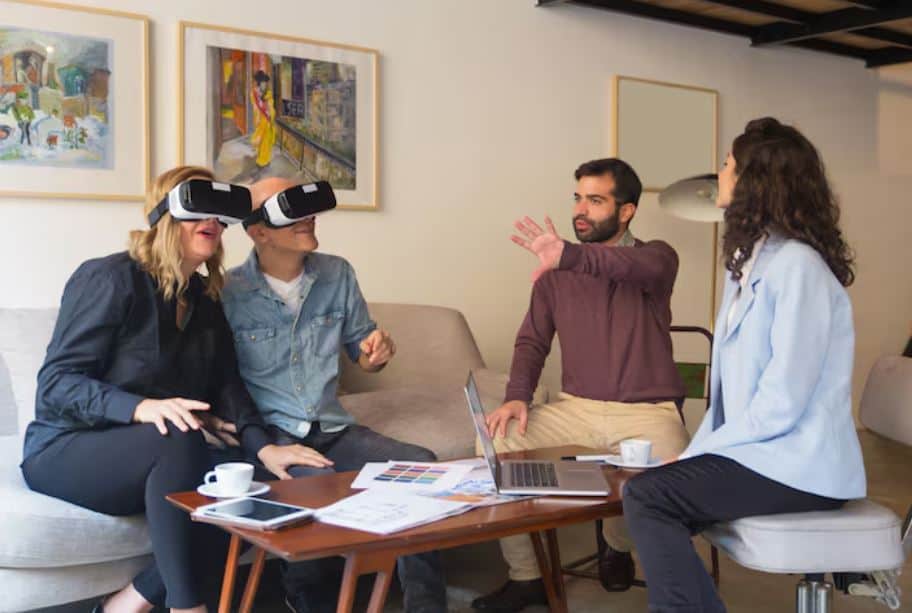
It has long been believed that empathy is a fundamentally human quality that is shaped by emotional connection and life experience. Virtual reality, however, is subtly changing that presumption. Virtual reality (VR) is proving to be an extraordinarily versatile bridge between feeling and understanding by allowing users to experience another person’s hardships firsthand, whether it’s a patient suffering dementia or a civilian experiencing a tense police encounter.
The question of whether VR can teach empathy has changed in recent years to one of how well it can. Weeks after experiencing homelessness electronically, individuals showed more compassion than those who only read about it, according to Stanford University researchers. The emotional resonance was quite powerful, demonstrating how immersive simulation can foster a sense of humanity that is frequently unattainable through standard educational methods.
| Detail | Description |
|---|---|
| Focus Area | Virtual Reality (VR) for Emotional Intelligence and Empathy Development |
| Key Technologies | Immersive Simulations, AI-Powered Scenarios, Haptic Feedback, 360° Interaction |
| Industries Using It | Healthcare, Law Enforcement, Corporate Leadership, Education |
| Leading Innovators | Stanford University, University of New England, Axon VR, SweetRush, MIT Horizon |
| Major Benefits | Emotional Engagement, Perspective Shifting, Safe Training Environment, Deep Retention |
| Authentic Source | Stanford Graduate School of Education – VR Empathy Study |
Empathy is a tool, not merely a virtue, in the medical field. To assist students understand what it’s like to live with dementia or age-related decline, medical educators at the University of New England are utilizing virtual reality. Trainees encounter vulnerability in a way that is profoundly transformational, whether they are navigating hazy hospital hallways or having trouble understanding muffled conversation. “Stepping into someone’s fragility before stepping into the profession,” as Dr. Marilyn Gugliucci puts it, is a method that has significantly enhanced future caregivers’ ability to interact with and respond to patients.
A similar mindset is being adopted by law enforcement organizations. The TASER’s manufacturer, Axon, has emerged as a surprising pioneer in the use of virtual reality for empathy training. Officers can view through the eyes of people with anxiety problems, schizophrenia, or autism thanks to its modules. Officers might have firsthand knowledge of behaviors they might otherwise misinterpret by suffering sensory overload or emotional distress. The findings are very novel: cops who have received VR training show improved de-escalation outcomes and increased emotional awareness.
The vice president of Axon, Pam Petersen, puts it this way: “We’re teaching officers to recognize humanity before reaction.” Her statement encapsulates a larger cultural change in which empathy is viewed as a highly effective talent with quantifiable impact rather than as a sentiment. Intentionally using empathy enhances communication and decision-making at all levels of public service.
Businesses are also starting to understand that empathy is profitable. VR-based empathy modules are being purchased by companies such as Walmart, Deloitte, and Vodafone for their leadership teams. Through these experiences, managers might adopt the viewpoints of their staff, clients, or even underrepresented voices in their companies. Executives can develop their ability to respond patiently and mindfully by virtually experiencing bias, exclusion, or high-pressure conversations. It’s a really successful development in corporate training that turns empathy from a catchphrase into a quantifiable leadership skill.
This has been transformed into an art form by the creative learning company SweetRush. To help business executives understand the realities of frontline workers, they created a virtual hotel setting. Participants developed a greater understanding of the difficulties involved in day-to-day operations by virtually checking in visitors or cleaning rooms. John Carlos Lozano, the chief creative officer, described it as “a mirror experience,” intended to let leaders see not what they oversee but who they affect.
Academics have done the same. The Shelton Leadership Center and MIT Horizon were the first to develop virtual reality (VR)-based leadership and negotiation simulations that allow users to see conflicts in the workplace from several angles. In one scenario, users are forced to face their own preconceptions and prejudices by switching between the roles of a manager and a young employee. The result is “learning that transforms introspection into action,” according to Debbie Acker of MIT, where empathy becomes both analytical and affective.
VR empathy training has several advantages. Instead of fostering intellectual recall, its immersive approach promotes active learning by fostering emotional memory. Participants experience a psychological phenomena that fosters compassion and resilience: they feel as though they’ve been there. Research demonstrates that this strategy improves long-term empathy memory and aids people in navigating challenging interpersonal situations with noticeably increased awareness.
Additionally, VR makes it safe for people to fail. In addition to receiving immediate feedback, trainees can practice challenging dialogues and try out various communication philosophies. Because emotional intelligence has a direct impact on results, the approach is especially helpful for people in leadership, education, and healthcare. It provides a safe environment where practicing empathy is just as important as talking about it.
However, experts agree that virtual reality is not a panacea. According to research, it mostly improves emotional empathy—the capacity to experience another person’s emotions—rather than cognitive empathy, which entails comprehending the reasons for another person’s feelings. The requirement for balanced learning—emotional exposure combined with introspection and dialogue—is highlighted by this seemingly insignificant discrepancy. The technology is quite comparable to a stage in that it sets the scene, but the human performer is still responsible for the performance.
VR empathy is becoming popular in the creative industry as a revolution in storytelling. Immersion documentaries have been utilized by journalists and filmmakers to provide viewers a first-hand look at societal issues. By immersing viewers in Syrian refugee camps, initiatives like the United Nations’ Clouds Over Sidra project translate sympathy into something more profound—an embodied sense of suffering. Immersion media can change behavior as well as perception, as demonstrated by the notable improvements in policy support and charitable engagement brought about by these experiences.
Celebrities have started to support these empathy-based projects. In his partnership with UNICEF, actor Orlando Bloom used virtual reality to draw attention to the hardships faced by children in war-torn regions. In a similar vein, viewers may stand where news occurs instead of just reading about it thanks to the New York Times’ “The Daily 360” project, which provided immersive reporting. In an age of digital detachment, this type of storytelling empathy has proven especially helpful in bridging emotional distance and assisting audiences in reestablishing a connection with human experiences.
The market for VR empathy tools is growing quickly. Industry analysts predict a billion-dollar training sector that includes diversity education, healthcare empathy programs, and soft-skill development. AI-driven avatars that react dynamically to voice tone and emotion are being incorporated by startups like SPARK Emerging Technologies and Takeaway Reality, giving simulations a more realistic feel. Compared to conventional training cycles, this evolution is far faster and yields data-rich feedback on the development of empathy and communication.
However, the capacity to personalize is where VR empathy training really shines. It converts intangible knowledge into altruistic action by fusing emotional experience with critical thought. It serves as a reminder to participants that empathy is a practice rather than an idea. Users absorb what they’ve experienced through guided discussions after simulations, connecting virtual experience with real-world behavior.
“VR doesn’t replace empathy—it reignites it,” as Stanford researchers so eloquently put it. The spark is provided by technology, but it is maintained by human intention. Technology is helping people rediscover a basic reality, whether it is utilized in corporate boardrooms, hospitals, or classrooms: its greatest accomplishment is not replacing human emotion, but rather assisting us in remembering how to feel it more profoundly.