

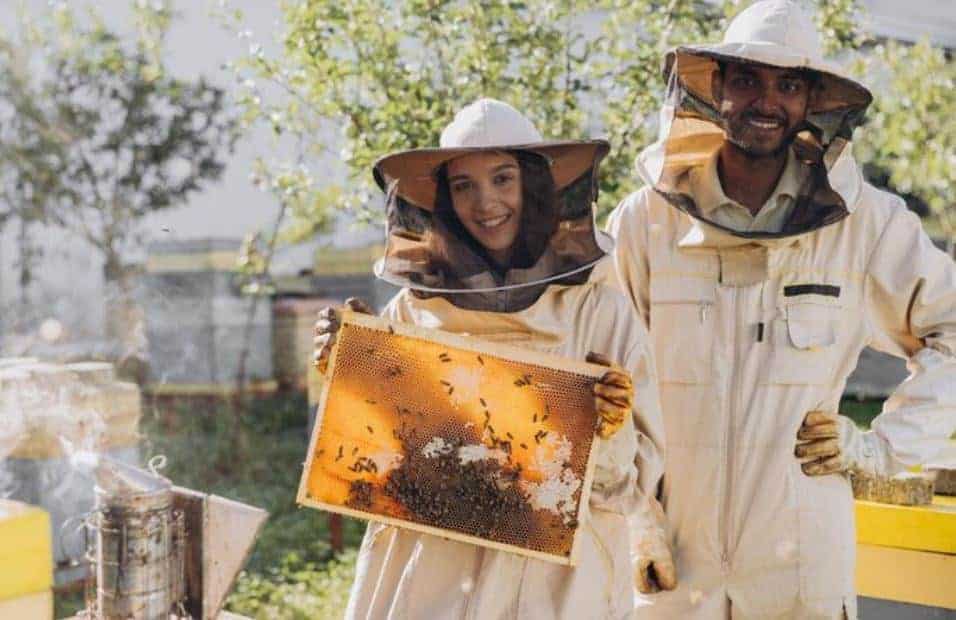
The precision of artificial intelligence and the natural rhythm of beekeeping came together in an unexpected way. Given that one is data-driven and digital, while the other is based on ancient intuition, the two may appear to be diametrically opposed. Together, though, they are changing the way that people treat their smallest agricultural allies. AI and beekeeping’s unlikely alliance has grown into a quiet revolution that combines biology and technology to save one of nature’s most vital species.
For centuries, beekeepers used their intuition to determine whether the hive was healthy or in distress by listening to its hum. However, traditional knowledge was challenged as bee populations drastically decreased, with entire colonies disappearing from farms. A faster, more accurate, and remarkably effective method was required for modern beekeeping. The new ally was artificial intelligence, which can identify hidden patterns in behavior, temperature, and sound.
| Key Aspect | Detail |
|---|---|
| Core Idea | Artificial Intelligence and beekeeping are merging in a data-driven effort to protect bee colonies, enhance honey production, and restore ecological balance. |
| Key Innovators | BeeWise, BeeHero, BeeOdiversity, ApisProtect, MyApiary, and Microsoft’s AI for Sustainability division. |
| Main Applications | Real-time hive health tracking, disease detection, acoustic analysis, predictive modeling for colony collapse, and ecosystem biomonitoring. |
| Societal Impact | Stronger pollination, more sustainable agriculture, and improved biodiversity protection across regions. |
| Reference | www.snapteams.ai/employers/blog/ai-in-beekeeping |
Sensors in today’s “smart hives” silently collect data every second, tracking hive weight, temperature, humidity, and vibrations. After that, AI analyzes this data stream to find early indicators of illness, stress, or parasitic invasion. It provides a digital translation of what the bees are unable to express, much like having a stethoscope constantly pressed against the hive’s heart.
Businesses such as BeeHero have emerged as industry leaders. BeeHero gathers millions of data points every day by installing micro-sensors in hives spread throughout large agricultural fields. These signals are converted into information about colony behavior and pollination intensity by its AI platform. For maximum yield, farmers now know precisely when and where to relocate hives. This data-driven strategy has greatly decreased colony losses and increased pollination rates, providing a lifeline to bee-dependent industries.
With its “Beehomes,” self-governing robotic hives, BeeWise advanced the idea even further. Multiple colonies are housed in each unit, which also automatically regulates humidity, temperature, and pest control. Every frame of the hive is monitored by AI algorithms inside, which notify beekeepers via an app if something appears amiss. The system is very effective; it gives bees a more stable environment while lowering labor and mortality rates.
Traditional beekeepers are being empowered rather than replaced by these innovations. Modern apiarists now use AI dashboards to see beyond what human eyes can detect, much like a doctor uses MRI scans to understand a patient. Precision beekeeping is a combination of analytics and art.
Big businesses have joined this endeavor as well. Microsoft’s BeeOdiversity project transforms bees into organic environmental sensors by using AI to analyze pollen that they collect. Scientists can identify pollution levels, pesticide presence, and changes in biodiversity in particular areas by examining that pollen. The bees are collecting the very information that aids in the preservation of their own ecosystems, driven by their innate instincts. The feedback loop between nature and technology is incredibly poetic.
Machine learning models are being used by researchers to forecast Colony Collapse Disorder, one of the biggest risks to beekeeping. Artificial intelligence can predict collapse weeks in advance by analyzing minute temperature variations and acoustic shifts. These particularly creative predictive insights enable beekeepers to take early action, preventing colonies from disappearing overnight. Giving hives their own early warning system is the same thing.
Particularly intriguing has been the application of sound data. Researchers have found that when the queen bee is absent, stressed, or hungry, bees produce unique frequencies. AI is now able to interpret the “mood” of the hive by feeding these sound patterns into neural networks. It’s a completely new way for people and bees to communicate; it’s silent but incredibly educational.
Family-run farms can now use AI thanks to smaller startups like ApisProtect. Through smartphone apps, their plug-and-play sensors offer real-time insights. Notifications about anything from unusual humidity to pest infestation are sent to beekeepers, making management less intrusive and more responsive. This strategy lowers barriers for small-scale producers who previously found it difficult to compete and is surprisingly economical.
The relationship between apiculture and technology took on new significance during the pandemic. Leigh-Kathryn Bonner, a fourth-generation beekeeper, established Bee Downtown, which set up smart hives on business campuses. Employees started using live video feeds to remotely check their bees after offices closed. What began as an engagement program turned into an unexpected symbol of resilience, a reminder that ecosystems survive through connection even when they are isolated.
However, as AI is incorporated into agriculture, it also poses a crucial query: can environmentally beneficial technology inadvertently cause harm to the environment? The energy requirements of AI data centers may exacerbate climate stress, which would have an indirect impact on pollinators, according to a University of Sydney study. Experts, however, note that AI may also contribute to the solution. Businesses like Google and IBM are developing more environmentally friendly AI infrastructures by switching to renewable energy sources. Innovation and sustainability can coexist in a delicate but manageable way.
It’s interesting to note how AI research has been impacted by bees themselves. The collective behavior of bees serves as the inspiration for the idea of “swarm intelligence,” which is used in autonomous robotics and drone coordination. Their capacity for group decision-making through the waggle dance, a rhythmic motion used to exchange information about nectar sources, served as a model for AI systems that collaborate to solve challenging issues. It’s a remarkable reversal: machines learning to think collectively from bees, and bees learning to survive from machines.
Additionally, the collaboration between AI and beekeeping has impacted environmental and cultural perspectives. It is being used more and more by ecologists and artists as a metaphor for coexistence, in which human invention coexists peacefully with nature rather than dominating it. Today, the gentle buzz of a hive serves as a reminder that empathy, not exploitation, can drive technology.
As part of national sustainability plans, governments and agricultural associations have started to finance AI-powered hive monitoring initiatives in recent years. Almond growers utilizing AI-assisted hives in places like California have reported better pollination cycles and increased crop yields. AI-assisted biodiversity monitoring has emerged as a key instrument for assessing ecological recovery in Europe.
This change feels very personal to contemporary beekeepers. Many people refer to AI as an invisible assistant that supports intuition rather than replacing it. Bees and humans have always had a respectful and observant relationship. Now, data that gives voice to what bees have always known strengthens that bond.
This collaboration is about more than just advancements in technology. It is a real-life illustration of harmony between automation and instinct, accuracy and patience. Algorithms have amplified the sound of a healthy hive, giving it a hopeful resonance. It implies that even the tiniest organisms can stimulate the most creative thinking and that the beating wings of a bee may hold the key to the future of innovation.